The final of the 1st National Youth Meteorological Science and Technology Innovation Competition, hosted by the Chinese Meteorological Society, concluded in Urumqi, Xinjiang on August 10. The project Observation and Mechanism Research on Macro Micro Properties of Clouds, submitted by Wang Yang, Li Jiming, Wang Yuan, Jian Bida, Zhao Yang and other researchers from Collegel of Atmospheric Sciences, Lanzhou University, was awarded the first class prize in the Basic Research Category.
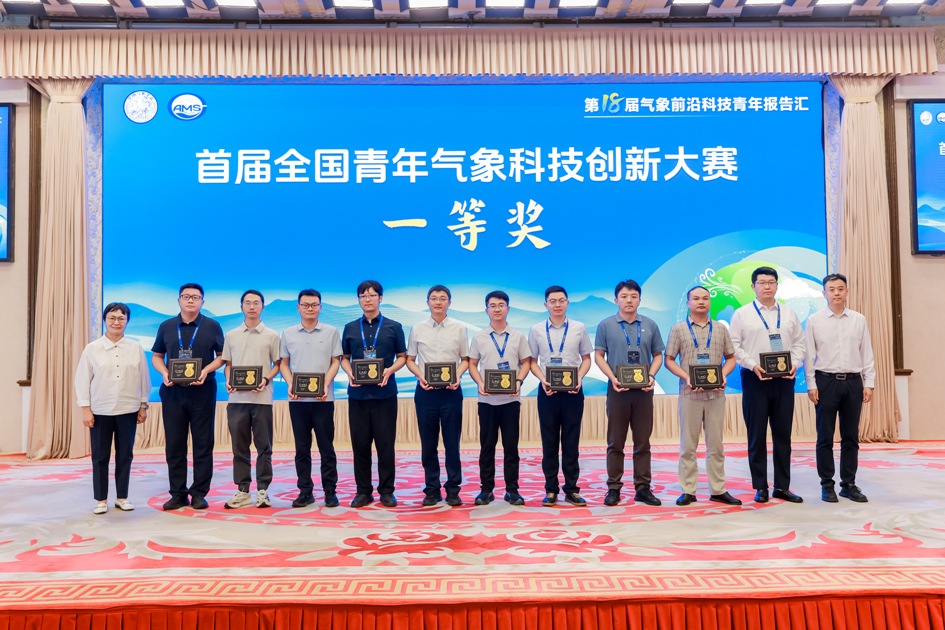
Photo: Award Ceremony
Launched at the beginning of this year, the 1st National Youth Meteorological Science and Technology Innovation Competition called for entries from universities, research institutes and meteorological institutions across the country. It set up four competition tracks: Basic Research, Application and Technology, Equipment and Engineering, and Artificial Intelligence. After preliminary evaluation, 10 first class prizes, 20 second class prizes and 50 third class prizes were selected in total. The final adopted the format of project presentation plus expert questioning. The review committee, composed of authoritative industry experts, university research backbones and front line meteorological operational specialists, conducted comprehensive assessment on entries in terms of scientific value, innovation level, research foundation and development potential. Shortlisted projects covered multiple cutting edge directions including fundamental meteorological theories, monitoring and early warning of severe weather, research and development of meteorological equipment, as well as interdisciplinary applications of artificial intelligence in meteorology. The award ceremony was held during the opening ceremony of the 18th Youth Symposium on Frontier Meteorological Science and Technology.
Clouds serve as a critical link connecting atmospheric water cycles, radiation budgets and weather climate processes. The correlation between cloud macro structures and micro physical processes remains a major challenge in atmospheric science, and also one of the key sources of uncertainty limiting the accuracy of weather forecasting and climate simulation. Centering on cloud macro structures, micro physical characteristics and their interactions, this team's project investigated cloud formation and evolution, phase transition and precipitation generation. By integrating multi source observation datasets and physical mechanism analytical methods, the team systematically studied the spatial temporal distribution, co evolution of macro micro properties of diverse cloud systems, as well as their responses to dynamic and thermal environmental conditions. Relevant findings provide scientific support for optimizing cloud microphysics parameterization schemes in numerical models, improving precipitation forecasting capability, implementing weather modification, and developing airborne cloud water resources.
In recent years, Professor Li Jiming's team has leveraged the unique features of climate and cloud precipitation processes in Northwest China, and carried out a series of continuous research covering comprehensive cloud precipitation observation, inversion of micro physical properties, formation mechanisms and parameterization improvement. This award fully recognizes the team's long term academic accumulation and innovation capacity. It also demonstrates the mission of the university's young faculty to pursue scientific frontiers and serve national meteorological development.
Taking this award as an opportunity, College will further promote interdisciplinary integration in cloud physics, cloud precipitation observation, atmospheric remote sensing and numerical simulation. It will keep supporting young researchers to conduct innovative studies targeting key scientific challenges in meteorology, so as to contribute to enhancing China's independent innovation capacity in meteorological science and technology, advancing high quality development of meteorological undertakings, and meeting national demands such as airborne cloud water resource exploitation.
Edited by: Ma Peiquan
