Recently, the research team led by Professor Huang Zhongwei from the School of Atmospheric Sciences, Lanzhou University, has published a paper entitled Integrated dataset of atmospheric bioaerosols over east Asia in the renowned international journal Earth System Science Data, which has been selected as a highlight paper by the journal (only 11 papers received this distinction in the past year). Based on extensive field observations of bioaerosols and adopting unified sampling and analytical protocols, this study has constructed a comprehensive observation dataset of atmospheric bioaerosols covering 45 sites across China, Japan, the Republic of Korea and Mongolia. It fills the gap of large-scale, highly-comparable bioaerosol datasets for East Asia, and provides a critical data foundation for further research on regional distribution patterns, climatic effects and health risks of bioaerosols.
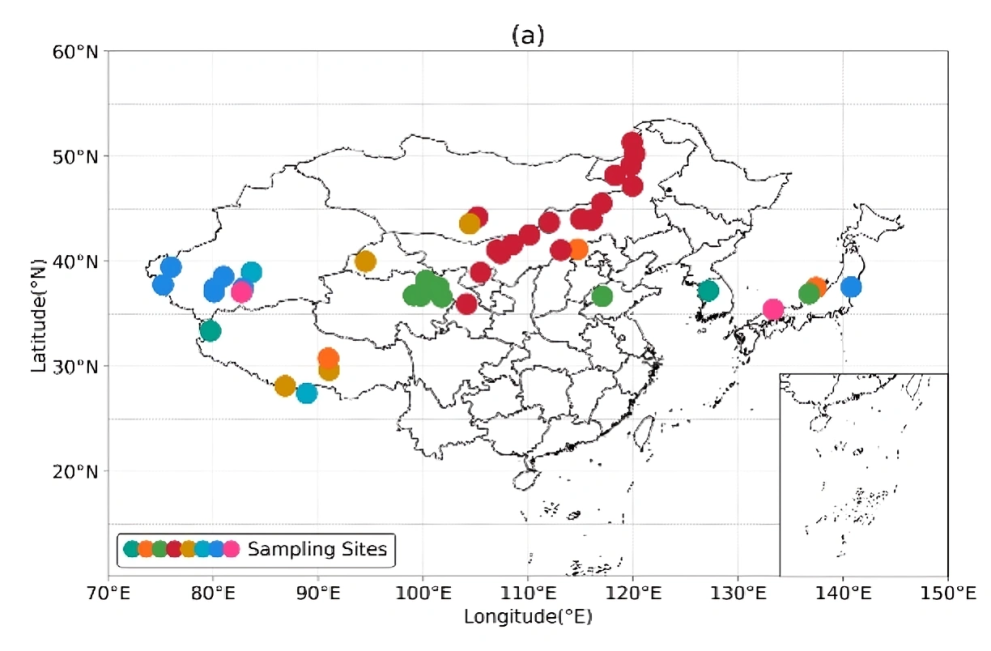
Figure 1. Distribution map of atmospheric bioaerosol sampling sites in East Asia, 2011-2021
Bioaerosols constitute an important component of atmospheric aerosols, originating primarily from natural emissions and human activities. Possessing both biological and aerosol properties, they exert substantial multifaceted impacts on climate, environment, ecosystems and public health. Nevertheless, due to scarce observational data and divergent research methodologies, large-scale distribution characteristics, key influencing factors as well as associated climatic and environmental impacts of bioaerosols remain poorly understood. East Asia features vast arid and semi-arid zones together with forests, grasslands, lakes and other land-cover types. Frequent spring sand-dust events transport air-masses toward densely- populated downstream regions, making potential hazards from bioaerosols particularly prominent in this area. Existing relevant studies remain fragmented without systematic syntheses.
To address the above-mentioned challenges, Lanzhou University's bioaerosol research team carried out large-scale bioaerosol observations across East Asia from 2011 to 2021. Sampling sites were deployed over dust source regions, transport pathways and downstream affected areas (e.g. grasslands). State-of-the-art international sampling and analytical approaches were applied consistently across the campaign. Fluorescence microscopy was mainly used to determine the number concentration of bioaerosols; 16S rRNA gene sequencing was employed to analyze the composition and diversity of atmospheric bacterial communities. Meanwhile, a self-developed fluorescence lidar system was utilized to detect vertical distributions of atmospheric bioaerosols. On this basis, the team further integrated meteorological variables (air temperature, relative humidity, wind speed and wind direction), air-quality parameters including PM2.5 and PM10, alongside satellite-retrieved aerosol optical depth and normalized difference vegetation index (NDVI). Thus East Asia's first comprehensive observation dataset for atmospheric bioaerosols was established.
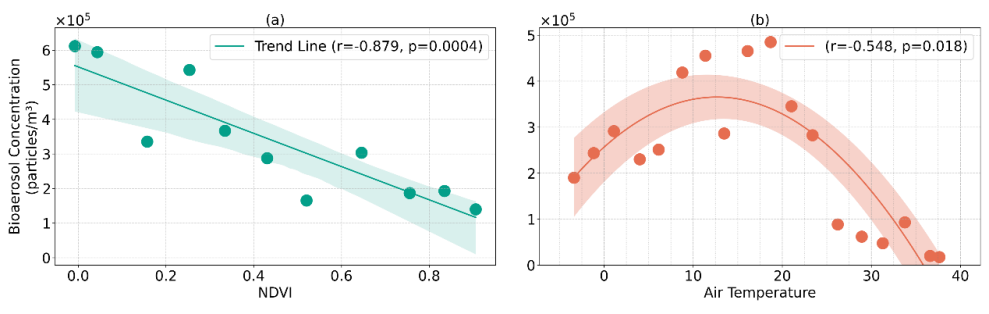
Figure 2. Relationships between bioaerosol number concentration, Normalized Difference Vegetation Index (NDVI) and atmospheric temperature derived from the comprehensive observation dataset
Analysis based on this dataset reveals pronounced spatial disparities in bioaerosol number concentration across East Asia. Furthermore, bioaerosol concentration shows a significant negative correlation with local NDVI, meaning that regions with sparser vegetation emit larger amounts of bioaerosols. Notably, bioaerosol concentration exhibits an evident non-linear relationship with air temperature, peaking at approximately 20°C.
Bacterial community analyses further demonstrate that the composition of dominant bacterial communities varies markedly with vegetation cover and atmospheric altitude. Soil-associated bacterial taxa prevail in low-vegetation areas; highly-tolerant genera are enriched at high altitudes, whereas plant related genera dominate in high vegetation regions. Bacterial α-diversity reaches maximum values under low vegetation cover and minimum values under moderate vegetation cover. Both the Shannon index and Chao1 index decrease as NDVI rises, with a more pronounced decline observed for the Chao1 index.
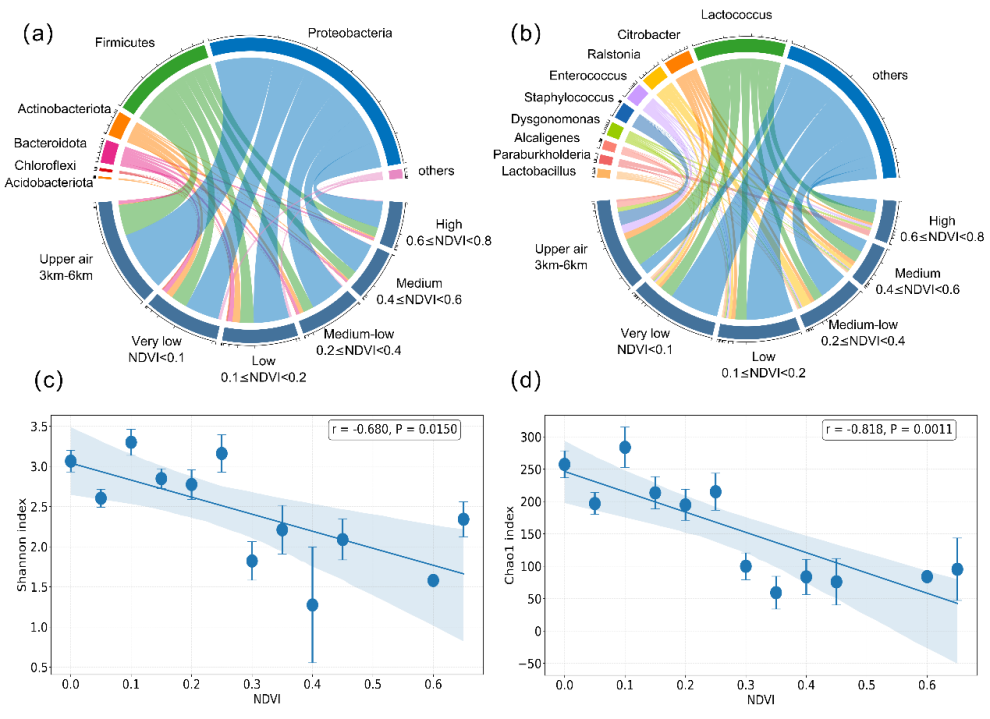
Figure 3. Distributions of dominant bacterial phyla and genera under different underlying-surface conditions, and correlations between NDVI versus Shannon and Chao1 indices derived from the comprehensive observation dataset
Moving forward, the team will continue to enrich the dataset, unravel interaction mechanisms between bioaerosols and the climatic-environmental system under global change, advance interdisciplinary integration between atmospheric sciences and life sciences, and support national priorities including biosecurity, climate governance and public health. Professor Huang Zhongwei is the first author of the paper; PhD candidate Zhang Wenjin serves as the second author; Academician Huang Jianping is the corresponding author. Lanzhou University is the primary affiliation of this publication. This research was funded by the National Key Research and Development Program of China, the National Natural Science Foundation of China, Major Science and Technology Projects of Gansu Province, and projects of Guangzhou National Laboratory.
The dataset is openly accessible on Zenodo. Requests for partial extended datasets may be submitted to the corresponding author.
Dataset download: https://doi.org/10.5281/zenodo.21337360
Paper link: https://doi.org/10.5194/essd-18-6191-2026
