In most people’s minds, the Qinghai-Tibet Plateau is a "pure land on Earth" with pristine snow-capped mountains and azure skies. However, in the eyes of scientists, there floats above this pure land an invisible "web of fine dust" that not only alters the plateau’s ecological environment but also profoundly affects global climate patterns.
To investigate the origins and fates of these tiny particles, a team of atmospheric and surface dust researchers led by Lanzhou University has climbed onto the Qinghai-Tibet Plateau more than a hundred times as part of China’s Second Comprehensive Scientific Expedition to the Plateau since 2019, exploring microscopic mysteries on the "roof of the world."
As an important component of Task 6 of the Second Tibetan Plateau Scientific Expedition, "Human Activities and the Safety of the Living Environment," the thematic project "Dust Aerosols and Their Climatic and Environmental Effects" has successfully accomplished all its scientific tasks over five years. Led by Lanzhou University under the leadership of Academician Huang Jianping, with the participation of researchers from the university’s School of Atmospheric Sciences and College of Earth and Environmental Sciences, and in collaboration with multiple institutions including the Institute of Earth Environment, Chinese Academy of Sciences, and the Institute of Tibetan Plateau Research, CAS, the project organized 92 sub-teams, totaling 12,273 person-days of field investigation on the Qinghai-Tibet Plateau, and collected 27,211 valuable dust samples. Through a three-dimensional "sky-earth coordinated" observation network, the team for the first time proposed the original scientific concept of "the Qinghai-Tibet Plateau as a global dust transfer station," contributing critical Chinese data to the construction of a national ecological security barrier.
Defining the "Transfer Station": Rewriting the Global Dust Cycle Paradigm
The Qinghai-Tibet Plateau is not only the geographical "roof of the world" but also a massive "heat pump" regulating global climate. Nevertheless, for a long time, the international scientific community has debated the physicochemical properties of dust aerosols over the plateau, failing to accurately quantify the plateau’s contribution as a dust source to atmospheric dust, or systematically reveal its key role in the global dust cycle.
What is an "aerosol"? Professor Tian Pengfei from the School of Atmospheric Sciences, Lanzhou University, a project liaison and core member, explained with a vivid analogy: "Just as adding sugar to water creates a solution, the system formed by tiny suspended dust particles in the atmosphere and air is an aerosol. What we focus on are the particulate matters."
These tiny, barely visible particles are key factors influencing the Earth’s climate system—they can both absorb sunlight to warm the atmosphere and scatter light to cool the ground.
To uncover the secrets hidden behind dust aerosols over the Qinghai-Tibet Plateau, the research team deployed a "sky-wide net" using self-developed multi-wavelength Raman-fluorescence lidar, establishing a continuous monitoring network in key areas such as Ngari, Yadong, and the Everest Base Camp, conducting three-dimensional, grid-based precise observations.
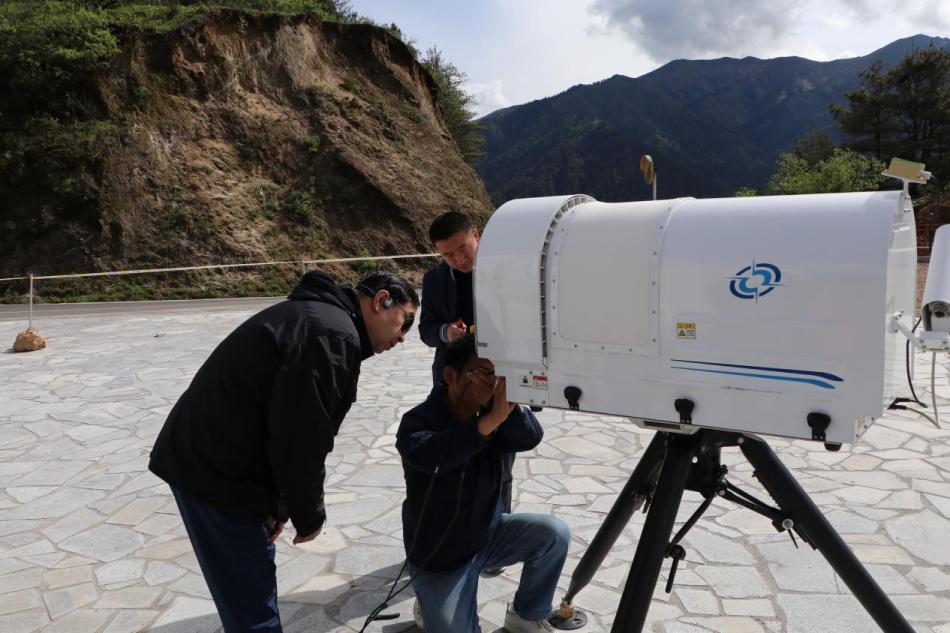
Expedition members conducting atmospheric dust surveys in Yadong; Academician Huang Jianping guiding the debugging of a microwave radiometer and lidar
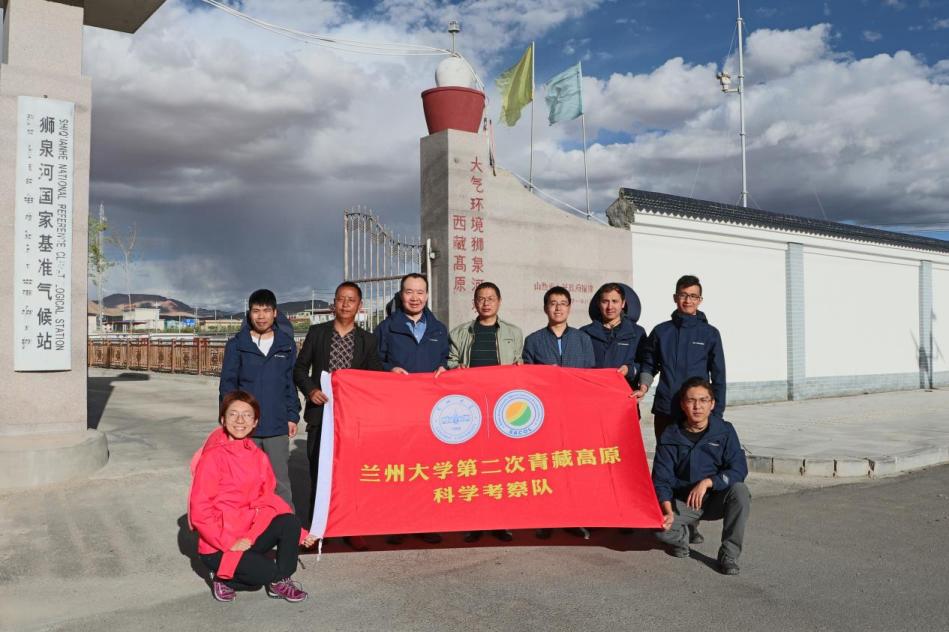
Professor Zhang Lei and expedition members conducting atmospheric dust surveys in Ngari

Expedition members conducting radiosonde experiments in the Namtso region
Whenever night falls, a striking green laser beam pierces the plateau’s dark sky, called the "light of exploration" by team members. Through this beam and the instruments, they collect first-hand experimental data. To ensure data quality and equipment safety, the team often has to stay in the field for months. On nights when thunderstorms might occur, they dare not even sleep in tents; instead, they sleep directly inside the observation shelter containing the lidar.
"The shelter has a circular opening on the roof for lidar detection. We sleep on the floor right next to the lidar. If it rains late at night and raindrops fall on our faces, we wake up immediately, cover the lidar with its protective shield, and use our bodies to protect state property and research data," recalled Tian Pengfei.
After five years of accumulation, the team obtained over 150 GB of observational data, compiled 37 publicly shared high-quality datasets, and achieved a series of original results on the physicochemical properties and radiative effects of plateau dust aerosols, correcting misconceptions from previous studies and accurately quantifying the contribution of dust from within the Qinghai-Tibet Plateau to atmospheric dust.
"Traditional numerical models struggle to accurately simulate dust emission processes over the plateau. Based on the massive expedition data, our team specifically developed a wind erosion factor dataset exclusive to the Qinghai-Tibet Plateau, achieving a key breakthrough in dust emission mechanisms—for the first time accurately quantifying the average annual dust release from within the plateau at approximately 258.8 Tg (about 258.8 million tons), solving the long-standing problem of accurately modeling plateau dust emissions," said Tian Pengfei.

Annual mean dust emission flux from within the plateau derived by the new method (upper left: annual mean dust emission flux; upper right: total annual dust emission
In addition to local natural release, surrounding regions with intense human activities, such as South Asia, continuously transport pollutants to the Qinghai-Tibet Plateau, making aerosol characteristics over the plateau complex. Moreover, because the plateau lies on the northern edge of the Indian Ocean, abundant water vapor is transported to the southern plateau, endowing clouds over the plateau with unique physical properties.
In response, the team discovered that the plateau’s "chimney effect" generated by its large topography transports dust and anthropogenic aerosols from Central Asia, South Asia, and Southwest Asia to the plateau and further up to the tropopause. They also found that dust from the Taklamakan Desert can be lifted to the northern plateau, while dust and anthropogenic aerosols from India can be transported to the southern plateau, participating in cloud formation over the plateau, altering cloud properties, and significantly affecting local precipitation.

Schematic diagram of aerosol-cloud interaction over the Qinghai-Tibet Plateau affecting precipitation
Led by Academician Huang Jianping, the team systematically integrated the above research findings and for the first time proposed the innovative theory of the "Qinghai-Tibet Plateau as a Global Dust Transfer Station": the plateau is not only an important local dust source but also, by virtue of its unique topography and thermal forcing, a key hub in global dust transport.
It can be said that the dynamic code behind aerosol "transfer" is as follows: under the coordinated relay of the Indian summer monsoon and the plateau's "heat pump effect," dust from the Middle East, Africa, South Asia, and other regions is "sucked" up to the tropopause and even into the stratosphere. Once these dust particles "reach the top," they spread globally with atmospheric circulation.
This discovery overturns the previous perception of the plateau merely as a receptor and establishes, from a physical mechanism perspective, the plateau’s irreplaceable role as a "regulator" in the global climate system.
Revealing the "Ecological Chain": Tiny Dust Drives Changes in Terrestrial and Marine Ecosystems
If this "dust" falls from the atmosphere to the surface, what impact does it have on the climatic and environmental effects of the Qinghai-Tibet Plateau? To answer this question, Professor Yang Shengli from the College of Earth and Environmental Sciences, Lanzhou University, led his team to conduct numerous important sampling missions across the vast land surface.
"Surface dust sampling requires finding profiles with clear stratigraphy and complete information; selecting sites must be extremely careful. Once, in Yushu, Qinghai, we spent three days searching for a representative sampling site with clear layers and complete signals. Eventually, with the help of a local excavator operator, we succeeded in sampling," recalled Yang Shengli.

Expedition members collecting loess dust samples in the Hengduan Mountains
After repeated validations, the team selected four regions: the middle and upper reaches of the Yarlung Tsangpo River, the Hengduan Mountain gorge region, the Tien Shan-Pamir area, and the Qilian Mountains-Altyn Tagh-Kunlun Mountains-Pamir area, organizing 58 surface dust scientific expeditions. The teams also conducted joint atmospheric and surface dust network expeditions, selecting 17 stations for field investigations and obtaining 1,821 precious samples.
"During a sampling mission near the Jinsha River, we worked until night. On our way back, two off-road vehicles broke down one after another. First one broke down; after it was repaired, the other got a flat tire halfway," recalled Yang Shengli. At that time, they were beside steep cliffs and a rushing river. The teachers and students worked through the night under dim headlights in the canyon, not returning safely to their base until late at night.
Professor Xia Dunsheng from Lanzhou University’s College of Earth and Environmental Sciences, the original leader of the surface dust team, sadly passed away due to illness in the later stages of the expedition, leaving an enduring pain in the team’s heart. In Yang Shengli’s memory, Professor Xia had an almost obsessive rigor regarding scientific expeditions. Even when feeling unwell, he always insisted on going to the field in person to confirm stratigraphy and sampling locations.

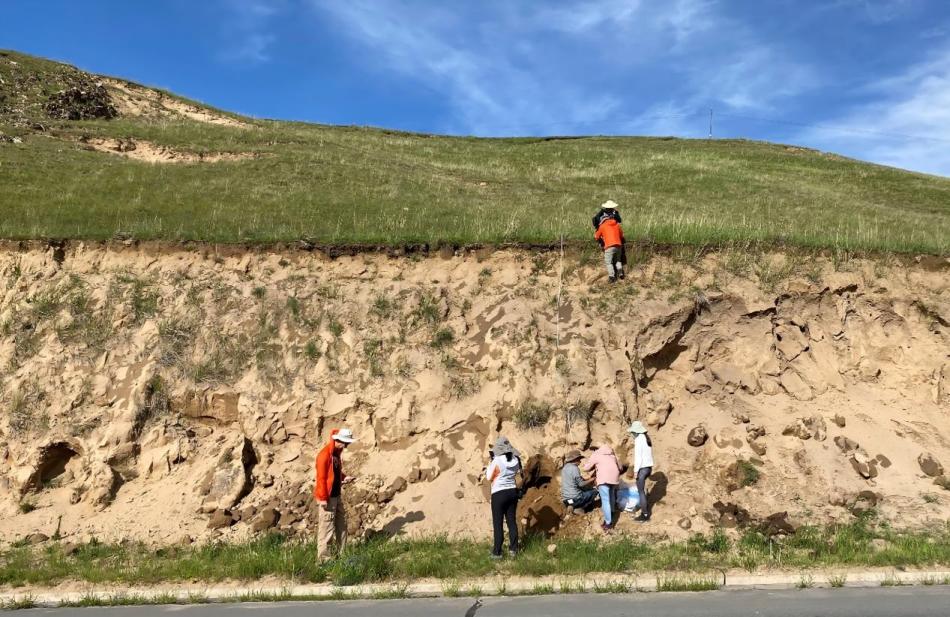

Expedition members collecting surface dust samples in the Yarlung Tsangpo River basin
In 2023, through the joint efforts of the expedition team, the expedition report *Spatial Characteristics and Evolution of Surface Dust in the Middle and Upper Reaches of the Yarlung Tsangpo River*, edited by Xia Dunsheng and Yang Shengli, was successfully published.
They discovered that the Yarlung Tsangpo River basin, located in the southern part of the Qinghai-Tibet Plateau, acts like a natural "dust archive." This surface dust is both a "nutrient reservoir" for crop growth and a threat to the human living environment on the plateau, even affecting climate change across East Asia and globally.
"Over the past six years, our team has traversed the Yarlung Tsangpo basin conducting field surveys, producing the first spatial distribution map of aeolian deposits. We found that this surface dust mainly originates from within the basin and has mostly accumulated since about 10,000 years ago. More importantly, we have deciphered the 'climatic code' of surface dust: the westerlies and monsoons jointly regulate humidity changes, while cold-season solar radiation and ice-volume-controlled plateau cold-season temperatures determine the intensity of dust activity. This dust not only profoundly affects the ecological environment of the Yarlung Tsangpo basin but can also ride the 'westerly express' to drift downwind, producing cascading effects on terrestrial and marine ecosystems along the way," said Dr. Yang Junhuai, a core team member.

Surface dust in the Yarlung Tsangpo basin and its climatic and environmental effects. Panel A shows the distribution, formation time, and material sources of surface dust; panel B reveals the global response and impacts of these high-altitude dust materials.
In May 2024, core expedition team member Professor Zan Jinbo from the Institute of Tibetan Plateau Research, Chinese Academy of Sciences, and colleagues published an important result in the top international journal *PNAS*, revealing the significant impact of Asian dust on the global environment: over the past 800,000 years, driven by global cooling and intensified glacial erosion on the Qinghai-Tibet Plateau, inland Asian dust activity has significantly increased. The nutrient-rich ferrous iron (Fe²?) contained in this dust is deposited into the oceans via atmospheric fallout. These "nutrient packages" from the plateau increased the iron flux to the North Pacific by 120%, greatly promoting the growth of phytoplankton, especially diatoms, thereby altering the carbon sink capacity of marine ecosystems. This discovery closely links plateau dust, marine ecology, and the global carbon cycle, and was honored as one of the "Top Ten Research Advances in Chinese Geographical Science in 2023" by the China Geographical Society.
From an inconspicuous speck of dust to revealing its impact on terrestrial and marine ecosystems, the wonderfully "butterfly-effect"-like outcomes of the plateau expedition continue to unfold before the eyes of scientists worldwide.
Tracking the "Trespassers": Effectively Supporting Major National Strategies and Regional Development
As an important ecological security barrier for China, the environmental safety of the Qinghai-Tibet Plateau attracts great attention. Aerosols over the plateau act like "trespassers," undergoing light scattering and absorption during their "transfer" process, producing significant radiative effects on the earth-atmosphere system.
To track these "trespassers," expedition members overcame challenges such as high-altitude hypoxia, complex geographic conditions in border areas, and sensitive operational environments, setting up multiple scientific stations on the plateau. These areas are often uninhabited, and completing each scientific mission represents an ultimate test of physical endurance and willpower.
"During the expedition, Yu Zeren, a Ph.D. student of the incoming class of 2021, stayed at the Yadong station for three full months to obtain complete monsoon data. To better deploy the expedition work, Academician Huang Jianping led a team onto the plateau, living and eating with team members for a week, carrying heavy observation equipment, and systematically planning next steps. Professor Zhang Lei from the School of Atmospheric Sciences, Lanzhou University, the second lead of the expedition thematic project who has since retired, also led a team to the foot of Mount Everest, conducting dust detection together with younger members under extreme conditions at an altitude of 5,300 meters," recalled Tian Pengfei.
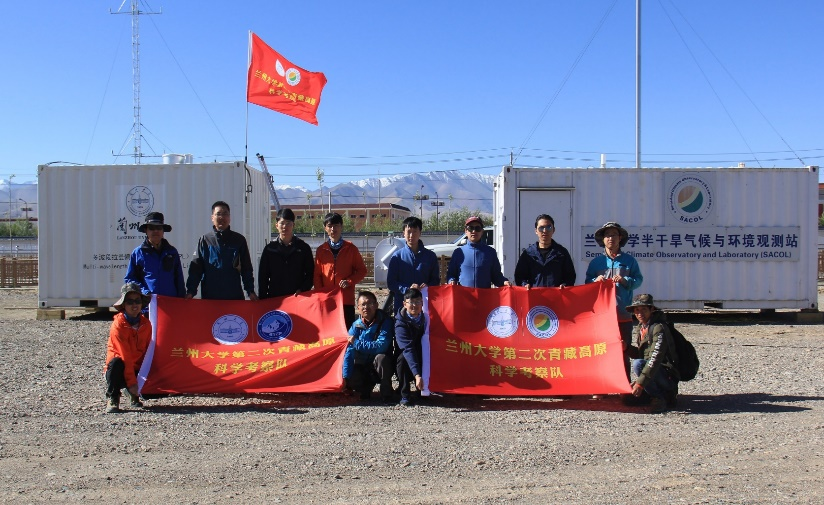
Joint atmospheric and surface dust expedition in the Ngari region of the Qinghai-Tibet Plateau
Hard work pays off. Based on observational data from stations such as Yadong and Everest Base Camp, the team found that the mountain-valley breezes between the Qinghai-Tibet Plateau and the South Asian subcontinent, together with local mountain-valley wind circulations on the southern slope of the plateau, jointly regulate the diurnal variation of dust aerosols on the southern slope of the plateau. This mechanism, together with the westerly circulation and the South Asian monsoon, determines the transport of South Asian pollutants to the Qinghai-Tibet Plateau.
"The single scattering albedo of aerosols is the ratio of scattering to the sum of scattering and absorption. Our research found that the aerosol size distribution in the Himalayan region does not exhibit the light-absorbing property proposed by foreign scholars; instead, it affects the regional radiative effect of aerosols by modulating the single scattering albedo," said Tian Pengfei.
This discovery corrects the erroneous understanding of foreign scholars regarding aerosol optical properties in the Himalayan region, thereby securing a stronger voice for China in relevant international environmental issues.
Based on systematic scientific findings and first-hand data, the team published a total of 115 academic papers over five years, including 70 SCI papers, with key results appearing in high-level journals such as *Nature* sub-journals, *Science Bulletin*, *PNAS*, and *BAMS*, and they have published two expedition reports. Notably, in the field of radiation safety, the team keenly recognized the importance of their scientific results for national ecological security and promptly produced advisory reports such as "Important Progress in the Study of Atmospheric Dust Radioactivity in the Southern Qinghai-Tibet Plateau," which received significant attention from relevant authorities.
From "invisible" dust to national-level strategic decisions, the expedition team has effectively "written their papers on the land of the motherland," constructing an invisible barrier to safeguard the ecological security of the plateau.

Two expedition reports published by the team
To maximize the value of these precious results from the "roof of the world," the team also established a data-sharing mechanism. All high-quality observational data generated by the expedition were rigorously compiled and made openly available to the public through the National Tibetan Plateau Data Center (https://data.tpdc.ac.cn).
"Looking back on the Second Tibetan Plateau Scientific Expedition, we have built close ties with local people and government departments on the plateau, received strong support from the state and local authorities, and established cooperative relationships with relevant research institutions in Belt and Road partner countries," said Tian Pengfei.

Academician Huang Jianping, project leader, signing a cooperation framework with a foreign representative
The expedition team’s home institution signed a memorandum with the Institute of Geology, Earthquake Engineering and Seismology of the Tajikistan Academy of Sciences to jointly address regional climate and environmental issues; it also established deep cooperation mechanisms with meteorological and environmental protection departments in Tibet, Qinghai, and various field stations, fostering the growth of more than 20 local young scientific and technological talents, leaving behind a "lasting" research force on the plateau.
"Beyond scientific outcomes, we also turned the Qinghai-Tibet Plateau into a vivid 'walking classroom', training a total of 80 graduate students. These young students ventured into no-man’s lands, honing their research skills through actual combat against hypoxia and severe cold. A new generation of young researchers is rapidly growing into pillars of national climate change research," said Yang Shengli.
The Second Tibetan Plateau Scientific Expedition has concluded successfully, but scientific exploration has no endpoint.
Building on the technical system established during this expedition, the Lanzhou University research team led by Academician Huang Jianping is actively promoting the construction of the Belt and Road Climate and Environment Observation Network, continuing to deepen research on the evolutionary history and environmental effects of surface dust on the Qinghai-Tibet Plateau and surrounding areas, and striving to solve common problems of dust and climate change in the Pan-Third Pole region, contributing ever more Chinese wisdom to the global effort to combat climate change.
