Every summer, students majoring in atmospheric sciences from more than ten universities across China gather in Lanzhou to take part in a comprehensive field internship spanning the Loess Plateau, crossing the Qilian Mountains and reaching the Qinghai Xizang Plateau. Far from an ordinary excursion, this event is a signature program of the School of Atmospheric Sciences, Lanzhou University — the National Joint Field Internship for Undergraduates Majoring in Atmospheric Sciences. During the internship, students operate instruments by hand, record observational data, and experience the shifts of weather in real world natural settings.
This scene epitomizes the reform and exploration for cultivating top notch innovative talents in atmospheric sciences at Lanzhou University. Though lacking the abundant resources enjoyed by eastern Chinese universities, the institution possesses unique geographical endowments where the Qinghai Xizang Plateau, Loess Plateau and Mongolian Plateau intersect. How can top notch innovative talents in atmospheric sciences be nurtured on land that may appear resource poor?
Not long ago, the project Geographical Empowerment and Three Chain Integration: Reform and Practice for Cultivating Top Notch Innovative Talents in Atmospheric Sciences at Western Universities, jointly submitted by Lanzhou University and Gansu Meteorological Bureau, won the Special Grade Incubation Award for National Level Undergraduate Teaching Achievement of Gansu Province (2026). Drawing on more than ten years of reform practice, the research team has established a new talent training system featuring geographical resource characteristics, four stage practical training, and in depth three chain integration. It delivers a replicable "Lanzhou University Model" for western universities to break resource constraints and cultivate distinctive talents.
Turning "Geographical Disadvantages" into "Educational Advantages"
According to Yang Yi, Deputy Dean of the School of Atmospheric Sciences and project lead, four intertwined major dilemmas confront western universities in cultivating top tier atmospheric science talents. First, there exist objective gaps in per student funding and high end equipment compared with peer universities in eastern China. Second, under traditional teaching modes, students excel at formula derivation yet struggle when confronted with real world weather systems and complex regional climate challenges. Third, the meteorological industry is rapidly expanding into emerging fields such as low altitude economy, new energy development and artificial intelligence applications, while relevant curriculum content lacks sufficient interdisciplinary integration. Fourth, a "mismatch between popularity and demand" exists between students' career aspirations and national strategic priorities.
"Fundamental problems cannot be solved merely by increasing resource input. In depth transformation of the talent training paradigm is imperative," Yang Yi commented candidly.
"Many view western China as a disadvantage, yet from another perspective it serves as a natural laboratory for weather climate research," noted Zhang Qiang, Member of the Chinese Academy of Engineering, adjunct professor of Lanzhou University and core member of the project. "Known as the 'Roof of the World', the Qinghai Xizang Plateau exerts profound impacts on weather and climate across East Asia and even the globe. We translate these unique geographical endowments into teaching resources, enabling students to identify and solve research problems through hands on practice."
The most groundbreaking conceptual innovation within the reform blueprint is the philosophy of translating geographical resources into teaching assets. Unique weather climate resources at the junction of the Qinghai Xizang, Loess and Mongolian Plateaus are transformed into a "Western Natural Laboratory" to boost students' practical capabilities, forming a distinctive comprehensive field internship platform. Launched by the school in 2015, the National Joint Field Internship for Undergraduates Majoring in Atmospheric Sciences has grown into a nationwide shared platform for practical education.

Figure: Map of distinctive comprehensive field internship routes for atmospheric sciences, a key component of the "Western Natural Laboratory"
"Students bring real world problems from field settings into classrooms. Learning shifts from rote memorization toward inquiry driven exploration of the unknown, achieving a fundamental pedagogical transformation from 'teaching centered' to 'learning centered' education." Yang Yi explained.
Three Chain Integration to Bridge the Gap Between Academia and Industry
Based at the Lanzhou University Meteorological Observatory, students run an official WeChat public account releasing real time weather forecasts, gaining direct front line operational experience. Multiple national level professional competitions are organized, where authentic practical problems drive hands on training and help students achieve a leap from knowledge accumulation to outstanding competence. Moving beyond the traditional "single final exam assessment", the school adopts a combined evaluation system of process oriented assessment plus competence oriented assessment.
The most salient feature of the school's reform lies in its new talent training system of Geographical Empowerment and Three Chain Integration: characterized by geographical resources, driven by four stage practical training, and underpinned by deep three chain integration.
As Yang Yi introduced, the system rests on two pillars. The first is a new practice driven paradigm empowered by geography and combining physical and virtual training. Breaking away from theory biased traditional pedagogy, it implements four progressive stages: field observation → virtual simulation → scientific research training → discipline competitions. The second pillar constitutes the new ecosystem of "Three Chain Integration", which deeply merges three dimensions: the teaching chain, centered on curricula and instruction; the research chain, anchored in national scientific research assignments; the operational chain, guided by cutting edge industry developments and operational requirements.
"This represents not merely methodological improvements, but a fundamental paradigm shift toward integrated education science talent cultivation," remarked Professor Huang Zhongwei, Dean of the School.
"We fully convert industrial resources into educational assets. In partnership with the China Meteorological Administration and Gansu Meteorological Bureau, we have co established the Lanzhou University Research Center for Earth System Numerical Prediction, with Academician Zhang Qiang serving as its director and Academician Shen Xueshun as its scientific director," said Professor Wang Chenghai, core member of the project. "A dual supervisor system is fully implemented throughout talent training, ensuring students' scientific innovation projects and thesis topics originate from real world industrial challenges."
Meanwhile, students undertake on site internships at meteorological bureaus and enterprises engaged in new quality productive forces. A graduate quality tracking feedback mechanism dynamically updates talent training schemes, so that the teaching chain keeps synchronized with the operational chain.
As Academician Zhang Qiang observed: "Deep dive engagement with meteorological operational systems further improves alignment between university talent cultivation and industrial demands."

Photo: Students undertaking internships at meteorological bureaus
Collaborative Advancement: Four Dimensional Integrated Approach for Reform Implementation
The school has independently developed national level virtual simulation courses such as Virtual Simulation Experiment on Dynamic and Thermal Effects of the Qinghai Xizang Plateau's Large Scale Terrain, removing temporal spatial constraints on learning. It has pioneered the "Finger Tip Classroom", delivering cutting edge science and technology content and micro lecture videos via Superstar Learning and WeChat course platforms to turn casual phone screen browsing into structured online study. Findings from national research missions including the Qinghai Xizang Plateau Scientific Expedition are adapted into vivid teaching cases. These are representative distinctive educational resources built by the School of Atmospheric Sciences.
Targeting bottlenecks in talent development and reconstructing training paradigms, the school advances systematic reform and practice via a four pronged integrated approach: resource consolidation, pedagogical reshaping, collaborative empowerment and value guidance.
In workflow design, the four progressive phases (field observation → virtual simulation → scientific research training → discipline competitions) are fully connected. Paired with integrated undergraduate postgraduate training that encourages "early lab access and early research engagement", the system fosters competence growth following the logic: problem identification → logical analysis → scientific inquiry → comprehensive teamwork. In terms of curriculum content, course groups are restructured around distinctive fields such as plateau meteorology and arid meteorology. Virtual simulation experiments, field observational datasets and research cases are organically embedded into course instruction. These reforms effectively mitigate the long standing dilemma of "abundant theoretical lectures yet difficult competence transformation". Problem oriented learning serves as a catalyst for capacity building, bringing about a fundamental shift from knowledge indoctrination to competence enhancement.

photo: hosted and co hosted national level professional events
Talent cultivation extends far beyond classrooms, with immersive value shaping playing a vital role.
The school carries out an educational program themed Spiritual Forging and Task Driven Cultivation to strengthen value guidance for young students. "We leverage participation in major national missions such as the Qinghai Xizang Plateau Scientific Expedition to cultivate patriotism and dedication while meeting national needs," said Tian Xulong, Party Secretary of the school.
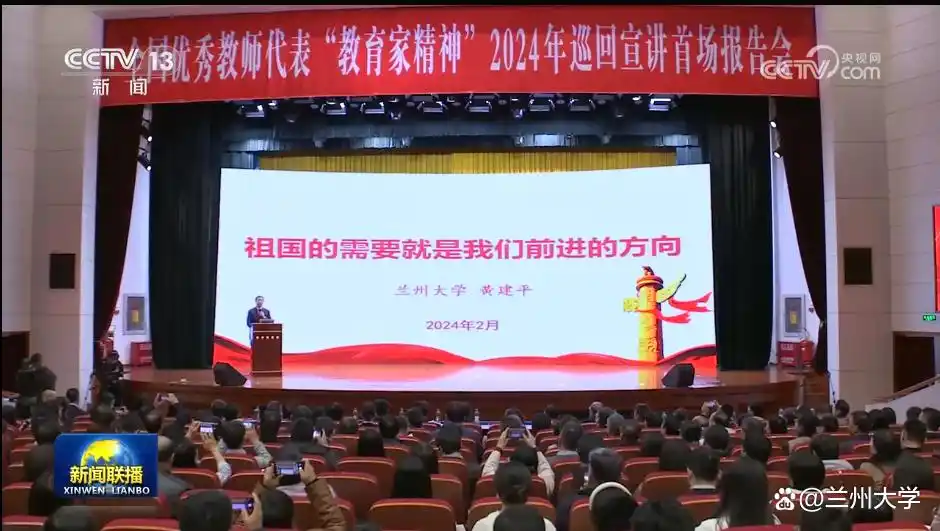
Photo: Academician Huang Jianping delivering a national tour lecture on the Spirit of Educators
Initiatives including the "Academician and Distinguished Master Lecture Series" and the undergraduate tutorial system concretize and contextualize the spirit of scientists and educators through personal example. The signature program Volunteer China Tour for Meteorological Disaster Prevention and Mitigation has run for fifteen consecutive years, with faculty and student volunteers covering 30 provincial level administrative regions and benefiting hundreds of thousands of people. Nearly 1,000 national defense meteorological professionals have been trained for the Chinese military; air force meteorology oriented national defense cadets from the school account for approximately 50% of the national total. Tangible outcomes of innovative talent training keep emerging.

Photo: Volunteers conducting meteorological science popularization outreach for the 15th year running of Volunteer China Tour for Meteorological Disaster Prevention and Mitigation
Rooted in Western China, Bearing Fruit for the Nation via Meteorological Science
More than ten years of continuous refinement and practical testing have yielded remarkable results.
Impressive Talent Training Outcomes
The further study rate for undergraduate students has jumped from 36.7% in 2016 to 67.8%. Forty eight alumni have grown into national level talents including academicians, accounting for roughly one quarter of top tier professionals in China's atmospheric science community. Graduates are widely recognized for their solid theoretical grounding, proficient operational skills and diligent work ethic. Around 80% of alumni take up posts in western China and national defense frontlines. Close to one hundred graduates serve as provincial chief forecasters or leading meteorological professionals. Distinguished role models have emerged, including recipients of the National May 1st Labor Medal, National Youth Post Expert Award, and China Young Female Scientist Award.
World Class Platform Development
The atmospheric science discipline has twice been selected for China's national "Double First Class" Initiative. It hosts a national level first class undergraduate major and a provincial level base for cultivating top notch students in basic disciplines, and has obtained approval for the Ministry of Education Virtual Simulation Innovation Laboratory for Atmospheric Sciences. Two national level first class courses and four provincial level first class courses have been constructed. Twelve distinctive textbooks have been published, among which four are selected for provincial level textbook planning projects.
Nationwide Dissemination and Shared Resources
The online course Numerical Weather Prediction is adopted by over 140 universities nationwide. The virtual simulation experiment Dynamic and Thermal Effects of the Qinghai Xizang Plateau's Large Scale Terrain is used by students from 43 universities. Mathematical Physical Methods in Atmospheric Sciences has been implemented across 58 higher education institutions. The National Joint Field Internship for Undergraduates Majoring in Atmospheric Sciences has become a nationally acknowledged brand practice teaching activity. Achievements from this project have been adopted by nine universities including Fudan University, Sun Yat sen University and Inner Mongolia University.
For over a decade rooted in northwest China, the School of Atmospheric Sciences at Lanzhou University draws on one of a kind western geographical resources to build a full chain educational pathway integrating teaching, research and operational practice. It has turned former locational limitations into fertile ground for distinctive talent development, and delivers concrete answers to the fundamental educational questions: who to cultivate, how to cultivate them, and for whom to cultivate them.
Today, the talent training system Geographical Empowerment and Three Chain Integration for top notch innovative atmospheric science talents stands as a vivid practice of Lanzhou University's commitment: taking root in western China and serving national strategic needs. More than a replicable and promotable "Lanzhou University Model", it offers powerful proof: guided by the country's core priorities and leveraging unique strengths, even wilderness can nurture thriving forests of talent.
Written by: Yang Yi, Wu Xueke, Shi Wanfeng, Wang Yaohui Edited by: Zhu Meiqi
