On the morning of April 17, a 12-member research delegation led by Chen Xiaojuan, Director of the Department of Science, Technology and Forecasting of the Ningxia Hui Autonomous Region Meteorological Bureau, visited the College of Atmospheric Sciences for a special research visit and discussion. Tian Xulong, Secretary of the Party Committee of the Sollege of Atmospheric Sciences, Li Jiming, Vice Dean, and teacher representatives of relevant disciplines of the college attended the discussion.
At the discussion, Tian Xulong extended a warm welcome to the delegation on behalf of the college. He stated that, as an important meteorological service unit in Northwest China, the Ningxia Meteorological Bureau has accumulated rich experience in meteorological monitoring and forecasting, disaster prevention and mitigation, and ecological meteorological services over a long period, providing a solid guarantee for regional economic and social development. As a discipline unit under the national "Double First-Class" initiative, the College of Atmospheric Sciences is currently optimizing its discipline layout, strengthening organized scientific research, and actively expanding emerging interdisciplinary fields such as the low-altitude economy in close alignment with the university's seven major actions: Consolidate Foundation, Lay Cornerstones, Build Networks, Empower Development, Expand Domains, Promote Digital Intelligence, and Gather Strength. It is hoped that this research will serve as an opportunity to further integrate the industry-university-research-application chain, closely combine the college's strengths in basic research with the operational platforms of the Ningxia Meteorological Bureau, and jointly build a highland for meteorological scientific and technological innovation and a talent training base.

Li Jiming detailed the college's progress in discipline construction, scientific research, and social services. Chen Xiaojuan noted that the purpose of this visit is to learn about the college's innovative achievements in cutting-edge meteorological science and technology, align with the specific implementation path of the university-bureau cooperation agreement, and jointly explore a new paradigm for the high-quality development of meteorological operations. She looked forward to in-depth exchanges to form practical cooperation plans in numerical model application, severe weather forecasting and early warning, ecological restoration-type weather modification, and climate resource development and utilization. Participants actively explored entry points for cooperation, and the two sides held in-depth discussions on topics including the development of modern meteorological forecasting technology, scientific and technological support for climate change response, atmospheric environmental monitoring and governance, and weather modification scientific experiments.
This research and discussion is an important practice for the College of Atmospheric Sciences to deepen the implementation of the "Expand Domains" action. Taking this cooperation as an opportunity, the college will further expand the application boundaries of meteorological disciplines, promote the in-depth integration of meteorological science and technology with various fields of economic and social development, and deepen practical cooperation in joint research on scientific projects, mutual sharing of high-quality resources, and collaborative cultivation of young talents.
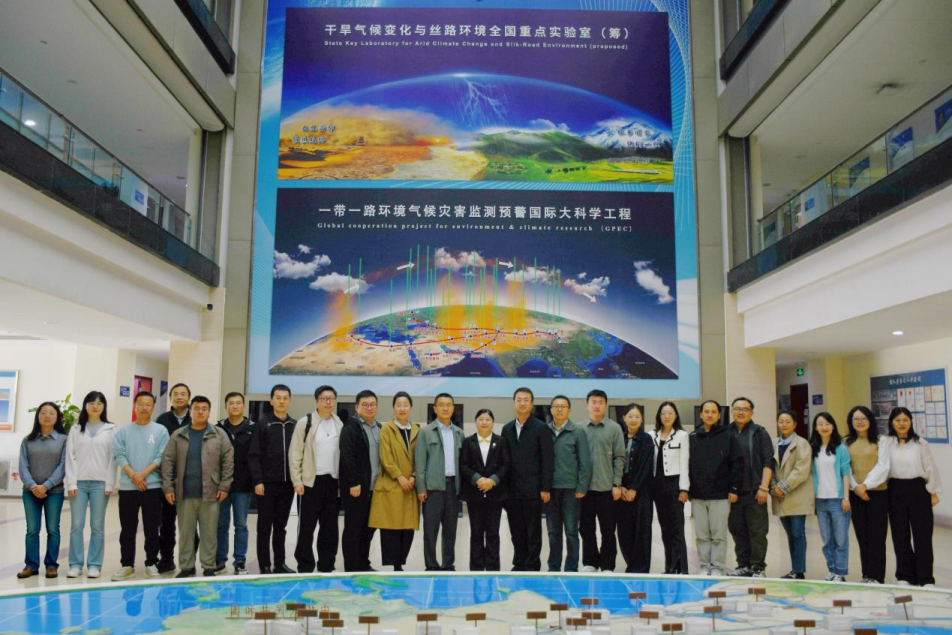
After the discussion, the delegation visited the college's scientific research achievement exhibition and the university history museum.
