Recently, a paper titled "Increasing Occurrence of Sudden Turns From Drought to Flood Over China" by the team of Professor Wang Shanshan from the College of Atmospheric Sciences, Lanzhou University, has been selected as a Top 10 highly cited paper for 2024 in the *Journal of Geophysical Research: Atmospheres*, following its previous recognition as a Clarivate ESI Hot Paper and Highly Cited Paper.
"Sudden turn from drought to flood" (STDF) refers to a phenomenon where a region experiences a prolonged period of antecedent drought followed by an abrupt onset of concentrated heavy precipitation. This severe drought-flood transition not only severely tests the capacity of water resource management and hydraulic infrastructure but also causes deep secondary damage to already fragile ecosystems and agricultural lands. Its disaster impact far exceeds the simple superposition of individual drought or flood events. This typical compound extreme climate event has become a key focus in disaster prevention and mitigation research in recent years. Based on observational data from 1961 to 2020, this study established a daily-scale STDF identification method, systematically quantifying and attributing its historical spatiotemporal characteristics, long-term trends, and driving mechanisms at the national scale.
The study employed the Standardized Precipitation Evapotranspiration Index (SPEI), which accounts for evapotranspiration, to characterize drought processes, while using regional precipitation percentile thresholds to identify extreme precipitation events (99.3% extreme threshold). Additionally, a Bayesian linear regression method was introduced to quantitatively separate the contributions of factors such as drought frequency, extreme precipitation frequency, and precipitation standard deviation.

Figure 1. Distribution of high-risk areas for sudden drought-flood transitions (STDF) from 1961 to 2020 and linear trend time series of STDF frequency. The black curve represents the 11-year moving average, and the red dashed line is the linear fit, passing the 90% significance test.
The study shows that STDF events in China have increased significantly (approximately 2.8 times per decade). High-risk areas are mainly concentrated in North China, Northeast China, and the Yangtze River Delta region, where the probability of a drought turning into a flood reaches nearly 35% in some areas. Seasonally, STDF exhibits a "south-north-south" distribution pattern that follows the movement of the rain belt, and the peak occurrence period has advanced by about one month compared with the historical average (from midsummer to early summer). Bayesian regression analysis reveals that the increase in STDF in North China and Northeast China is mainly driven by the intensification and increased variability of extreme precipitation, whereas in the Yangtze River Delta region it is more controlled by increased drought frequency, showing significant regional differences.
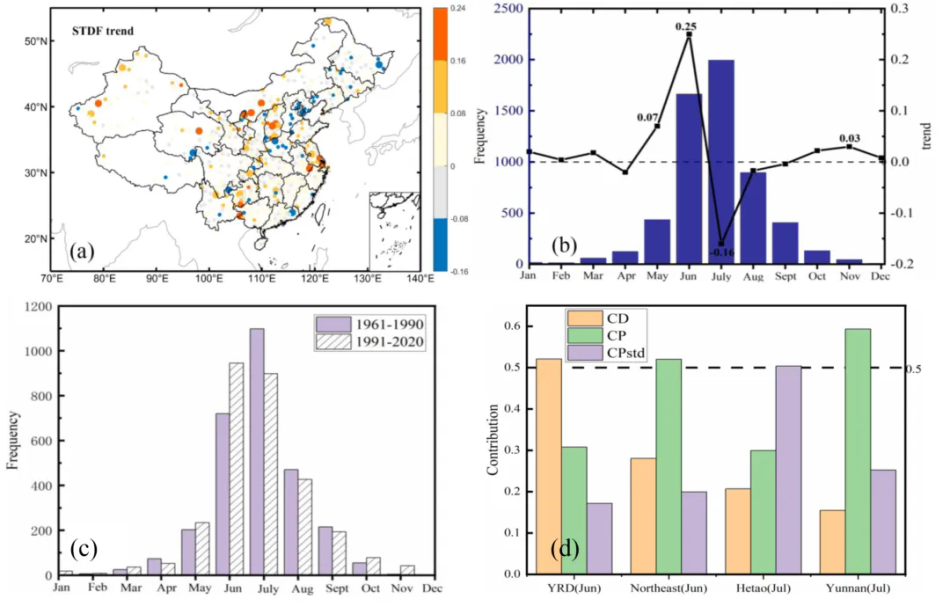
Figure 2. (a) Station-based trends of sudden drought-flood transitions (STDF) from 1961 to 2020. (b) Monthly frequency trend of STDF from 1961 to 2020. (c) Comparison of STDF occurrence months between the first and last 30-year periods. (d) Contributions of changes in drought frequency, extreme precipitation trends, and precipitation standard deviation to STDF.
This study systematically characterizes the long-term evolution of STDF events on a national scale, filling the gap in previous research regarding long time series and high temporal resolution analysis. The findings help deepen the understanding of the formation mechanisms of compound extreme hydrological events and provide important references for identifying critical risk periods and regions.
In the context of climate change, compound extreme events such as STDF pose higher demands on water resource regulation and disaster prevention and mitigation. This research can provide a scientific basis for early warning of meteorological disasters, flood control and dispatch in river basins, and coordinated management of drought relief and flood control, and has positive significance for enhancing regional capabilities to cope with extreme climate risks. The study was supported by grants from the National Natural Science Foundation of China (41991231, 42075018).
Paper link (*corresponding author): Wang, H., Wang, S*., Shu, X., He, Y., & Huang, J. (2024). Increasing occurrence of sudden turns from drought to flood over China. Journal of Geophysical Research: Atmospheres, 129(3), e2023JD039974.
https://doi.org/10.1029/2023JD039974
