Recently, the research team led by Academician Huang Jianping of Lanzhou University, in collaboration with Peking University, the Numerical Weather Prediction Center of the China Meteorological Administration (CMA), and the Urumqi Institute of Desert Meteorology of the CMA, has achieved a series of research advances on non-stationary turbulence in the atmospheric boundary layer. Focusing on the identification, classification, correction, and parameterization application of non-stationary turbulence in the atmospheric boundary layer, the research provides theoretical and methodological support for boundary layer turbulence studies over complex underlying surfaces. Relevant findings have been published in Geophysical Research Letters, Journal of Geophysical Research: Atmospheres, and Atmospheric Research.
First, the research team found that traditional stationarity test methods have significant limitations in identifying non-stationary turbulence affected by submesoscale disturbances, misclassifying a large number of non-stationary samples as stationary, with more than 60% of records being missed. To address this issue, based on a method for separating submesoscale and turbulent motions, the team proposed a new non-stationarity intensity index and a nine-level classification framework, offering a new tool for the quantitative identification of non-stationary turbulence over complex terrain and heterogeneous underlying surfaces (Xu, Ren* et al., GRL, 2026).

Figure 1 Missed detection of non-stationary turbulence under submesoscale disturbances by traditional stationarity tests
Second, starting from the microstructural characteristics of turbulence, the team distinguished and identified four typical states: no turbulence intermittency, large-scale turbulence intermittency, small-scale turbulence intermittency, and full-scale turbulence intermittency. It revealed the impacts of submesoscale motions and turbulence intermittency at different scales on the applicability of similarity theory. The results show that after removing the submesoscale component, the turbulent statistical structures of wind speed, temperature, and other variables in the surface layer are more consistent with the classical similarity theory. Accordingly, an empirical parameterization relationship between submesoscale motions and the Richardson number was established, providing a new basis for improving the representation of boundary layer turbulence (Kang, Ren* et al., JGR, 2025).
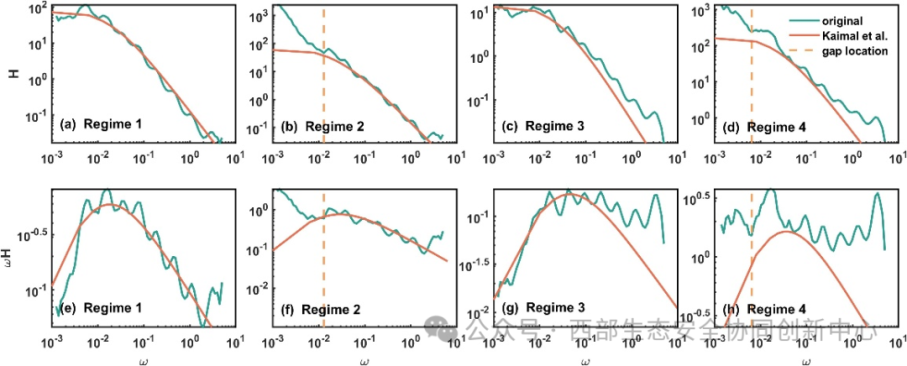
Figure 2 Four spectral classifications of non-stationary turbulence in the atmospheric boundary layer
Finally, targeting the typical desert underlying surface in northwest China, the team developed an automatic classification algorithm based on the microstructural characteristics of turbulence. It further clarified the systematic biases in the estimation of turbulent fluxes such as momentum and heat for different turbulence intermittency regimes, proposed correction schemes for different regimes, and outlined potential application workflows for numerical models. The results help deepen the understanding of boundary layer turbulent transport mechanisms under strong non-stationary conditions and provide scientific support for improving boundary layer parameterization schemes and enhancing the performance of weather and climate models (Kang, Ren* et al., AR, 2026).

Figure 3 Schematic flow chart of regime‐dependent correction and parameterization application for non‐stationary turbulence
This research was supported by projects of the National Natural Science Foundation of China and the National Key R&D Program of China. The first authors are Master’s students Xu Yue and Kang Peixuan from the College of Atmospheric Sciences, Lanzhou University. The corresponding author is Dr. Ren Yan, Young Professor at the Collaborative Innovation Center for Western Ecological Safety, Lanzhou University. Co-authors include Professor Zhang Hongsheng from Peking University; Researcher Wei Wei from the Numerical Weather Prediction Center, CMA; Researcher Mamtimin Ali, Assistant Researchers Wang Yu and Song Meiqi from the Urumqi Institute of Desert Meteorology, CMA; and Associate Professor Liang Jiening, Young Researcher Li Jiayun, Associate Professor Cao Xianjie, Professor Tian Pengfei, Professor Zhang Lei, and Professor Huang Jianping from the College of Atmospheric Sciences, Lanzhou University.
Paper Information
1.Xu Yue, Ren Yan*, Zhang Hongsheng, Kang Peixuan, Liang Jiening, Cao Xianjie, Tian Pengfei, Zhang Lei. 2026. Quantifying and Classifying Non-stationary Turbulence under Sub-Mesoscale Disturbances. Geophysical Research Letters. 53, e2026GL121634. https://doi.org/10.1029/2026GL121634
2.Kang Peixuan, Ren Yan*, Zhang Hongsheng, Liang Jiening, Tian Pengfei, Cao Xianjie, Li Jiayun, Zhang Lei. 2025. Modification of similarity relationships and parameterization of submesoscale motions under spectral regimes over uniform flat terrain. Journal of Geophysical Research: Atmospheres. 130, e2025JD044580. https://doi.org/10.1029/2025JD044580
3.Kang Peixuan, Ren Yan*, Zhang Hongsheng, Wei Wei, Xu Yue, Mamtimin Ali, Wang Yu, Song Meiqi, Liang Jiening, Zhang Lei, Huang Jianping. 2026. Impacts of full-scale turbulence intermittency on land-atmosphere interactions in the hinterland of the Taklimakan Desert. Atmospheric Research. 108782. https://doi.org/10.1016/j.atmosres.2026.108782
