Marine low clouds represent one of the most extensive cloud systems on Earth. Acting like natural parasols floating over the oceans, they strongly reflect solar radiation and play a critical role in regulating the energy balance of the Earth’s climate system. Nevertheless, climate models have long exhibited substantial biases in simulating marine low clouds. The resulting uncertainty in cloud-radiative feedback constitutes a core bottleneck limiting the accuracy of global-warming projections: there remains a wide range of estimates for how much the Earth will warm upon doubling atmospheric carbon-dioxide concentrations.
Addressing this cutting-edge international climate-research issue, the research team for cloud-physical-property remote sensing at Lanzhou University has innovatively proposed a new analytical framework for marine low-cloud changes based on co-effects of multiple meteorological factors. The framework markedly improves the capability of climate models to reproduce the spatial distribution of marine low clouds. Findings indicate that the radiative-feedback strength of future marine low clouds is substantially weaker than predictions from current mainstream climate models. This suggests that the climate system may be more “resilient” to carbon-dioxide emissions than previously thought. This work has recently been published in the journal Communications Earth & Environment.

In this study, the team systematically considered the joint influences of multiple meteorological elements on the formation, evolution and dissipation of marine low clouds. Using principal-component analysis (PCA), the team extracted dominant modes of co-variation among multi-dimensional meteorological variables, and organically integrated mathematical characterization with cloud-physical processes. A more stable and reliable relational model linking marine low clouds and meteorological fields was thereby established. Compared with conventional approaches that focus merely on single meteorological factors and are vulnerable to variable multicollinearity, the new framework achieves higher stability both temporally and spatially. Validated against multi-year satellite observations, the reconstructed spatial-temporal variations of marine low clouds from this method outperform direct simulations from state-of-the-art CMIP6 climate models in key metrics including correlation coefficients and root-mean-square errors (Figure 1).

Figure 1. Low-cloud fraction simulated by climate models (left column), low-cloud fraction derived from principal-component analysis (right column), and their comparisons against observations
On this basis, the research demonstrates that radiative-feedback contributions differ across distinct types of marine low clouds. The global-mean marine low-cloud radiative feedback is estimated at 0.09 ± 0.09 W m-2K-1 (Figure 2), only half the magnitude of mainstream results from prior CO2-doubling experiments. This implies that under realistic gradual global-warming scenarios, the reduction in marine low- cloud coverage may be less severe than earlier projections, and the associated positive radiative feedback will be correspondingly weakened. These outcomes not only deliver new theoretical and methodological support for understanding future evolution and climate-feedback mechanisms of marine low clouds, but also provide important scientific evidence for reducing uncertainties in climate-sensitivity projections and improving global climate-change prediction capability.
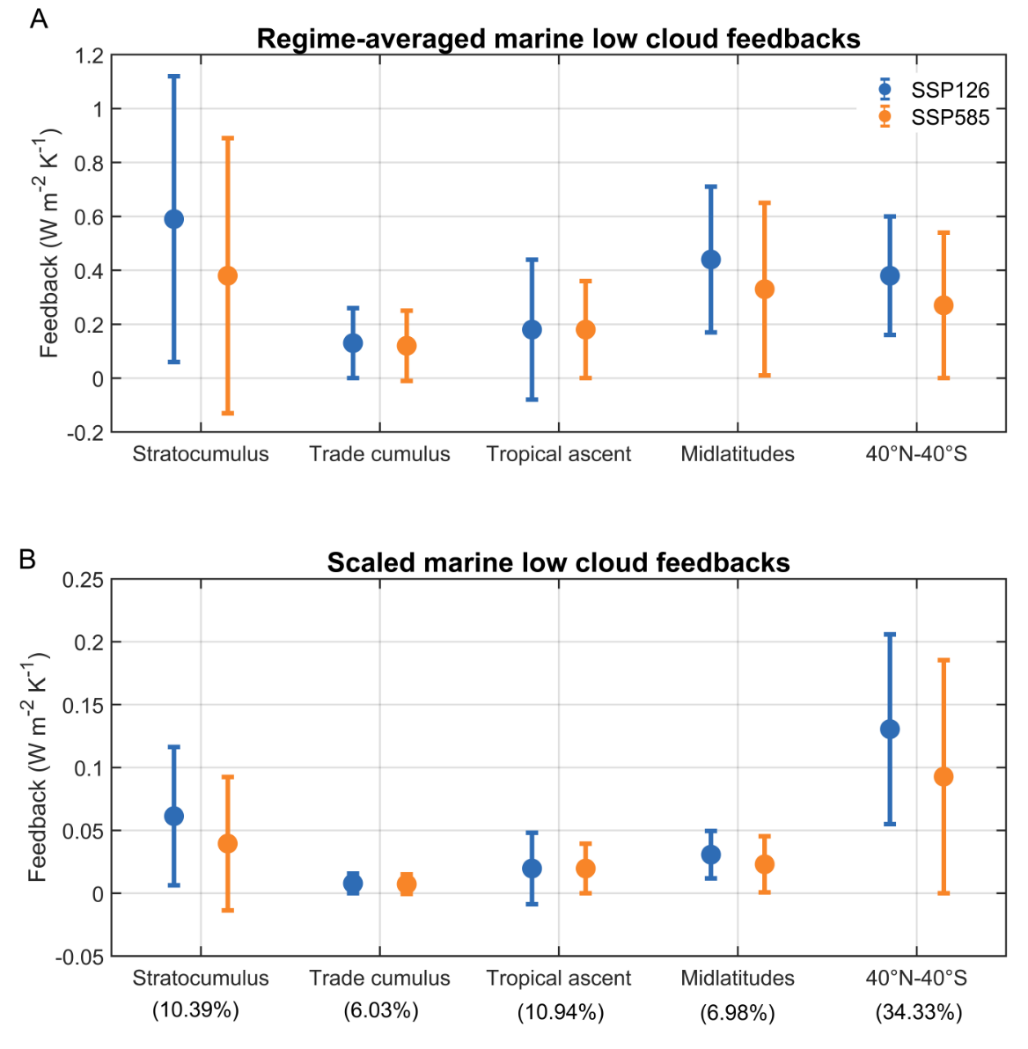
Figure 2. Radiative feedbacks and relative contributions of different marine low-cloud regimes across the globe
Professor Ge Jinming and 2022-entry PhD candidate Li Yize from the College of Atmospheric Sciences, Lanzhou University, are co-first authors; Academician Huang Jianping serves as the corresponding author. This research was supported by the Pioneer Project for Disciplinary Breakthroughs in Western Ecological Security (Grant No. JYB2025XDXM910) and projects of the National Natural Science Foundation of China (Grant Nos. 42427804 & 442275076).
Written by: Li Yize
Figures by: Li Yize
Edited by: Chen Jiaxing
