From October 27 to 28, the final round of the "Issue Announcement and Leader Selection" Special Competition (Next-Generation Information Technology Sector) of the 19th "Challenge Cup" National College Students’ Extracurricular Academic and Scientific Works Competition was held in Chongqing.
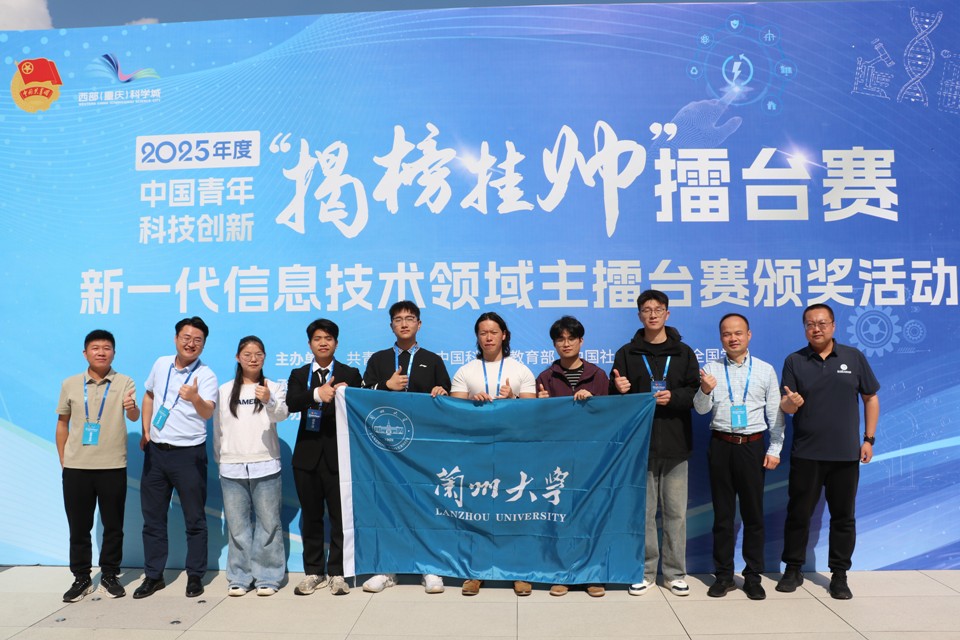
The student and faculty team of our university participated in the competition.
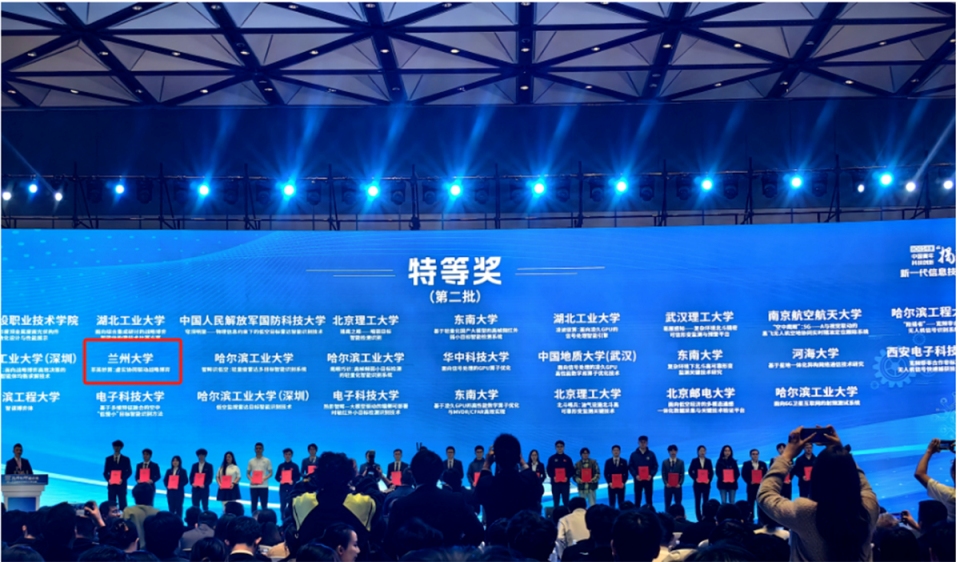
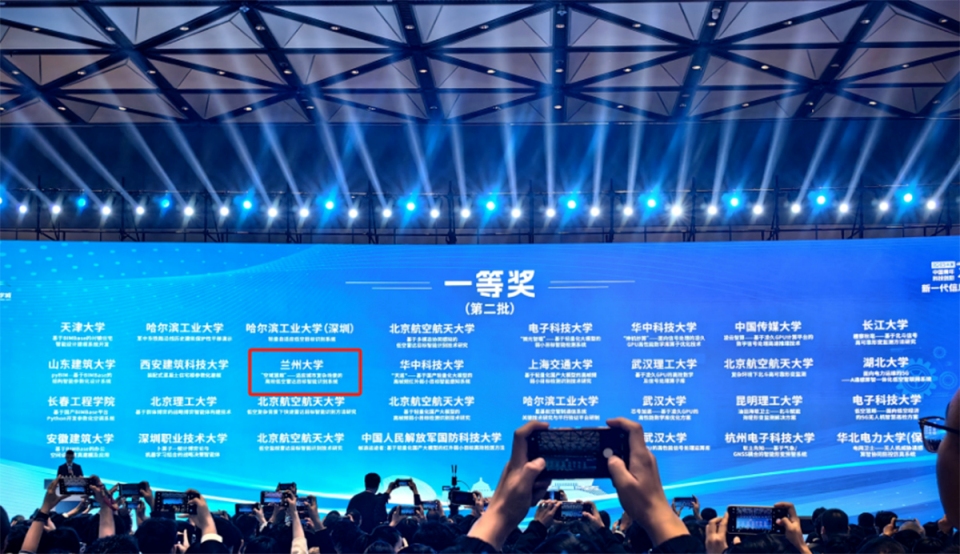
The entry Cuiying Smart Calculation: Strategic Game Driven by Virtual-Real Collaboration (supervised by Li Huale, Yang Zhen and Wang Zhaobin) won the Special Prize. The entry "Airspace Vision" – An Intelligent Low-Altitude Radar Target Recognition System for Complex Urban Scenarios (supervised by Ge Jinming and Cheng Yifan) won the First Prize. This marks another breakthrough for our university in recent years in the "Challenge Cup" National College Students’ Extracurricular Academic and Scientific Works Competition.
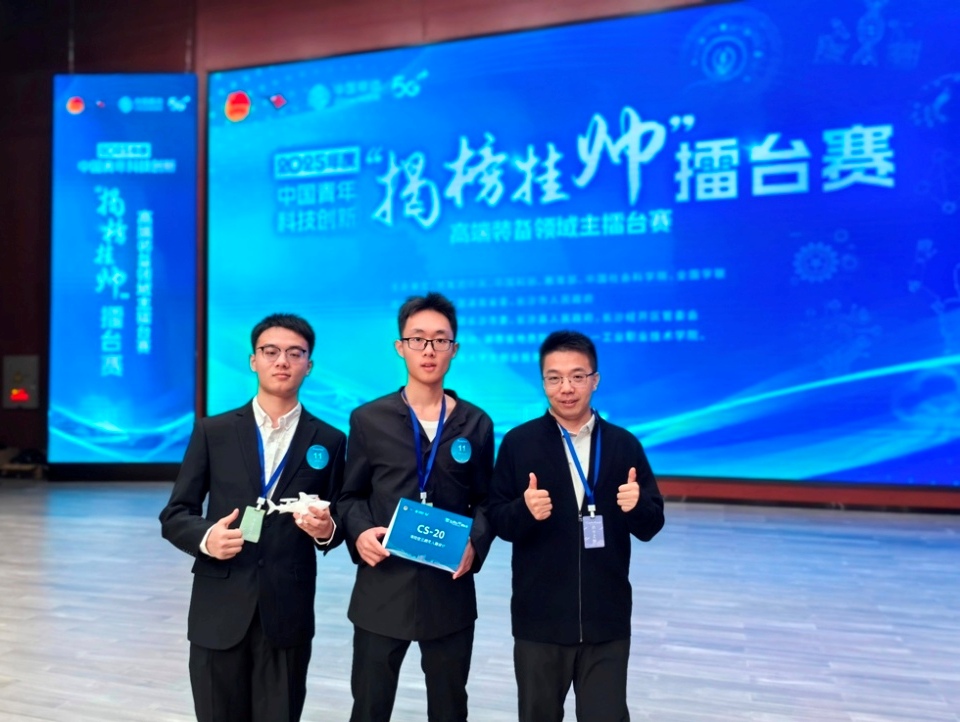
In addition, at the final round of the "Issue Announcement and Leader Selection" Special Competition (High-End Equipment Sector) held recently in Changsha, our entry Tri-Domain Pioneer: An Intelligent Unmanned Platform for Sea, Land and Air Operations (supervised by Ma Minjin and Shi Wanfeng) won the Second Prize.
The "Challenge Cup" National College Students’ Extracurricular Academic and Scientific Works Competition is co-sponsored by the Central Committee of the Communist Youth League of China, China Association for Science and Technology, Ministry of Education, Chinese Academy of Social Sciences, All-China Students’ Federation and the people’s government of the host province. It is known as the "Olympics" of scientific and technological innovation for Chinese college students. The "Issue Announcement and Leader Selection" Special Competition focuses on key core technologies and addresses major social and practical issues. Enterprises and public institutions put forward demands, the organizing committee issues open calls to universities and society, and student teams and young scientific and technological talent teams compete by undertaking the tasks.
Special Prize
Project Title: Cuiying Smart Calculation: Strategic Game Driven by Virtual-Real Collaboration
Competition Topic: CQ-07 Construction Technology of Strategic Game Agents for Comprehensive Integrated Seminars
Supervisors: Li Huale, Yang Zhen, Wang Zhaobin
Team Members: Xia Tong (Leader), Deng Yueting, Wang Zikun, Xiao Hang, Cai Dingzhong
Project Introduction: This project addresses decision-making challenges in multi-stage, information-asymmetric national strategic games. By integrating game theory and machine learning algorithms, it innovatively proposes the Deep Prism agent. It improves game information density through state representation reconstruction, and effectively tackles the explosion of state and action spaces in games via action abstraction and parallel architecture. Results show that Deep Prism maintains stable advantages against opponents of different styles. The project can provide reliable and efficient decision support for decision-makers in complex military strategic game scenarios.
First Prize
Project Title: "Airspace Vision" – An Intelligent Low-Altitude Radar Target Recognition System for Complex Urban Scenarios
Competition Topic: CQ-08 Research on Intelligent Target Recognition Technology for Low-Altitude Surveillance Radars
Supervisors: Ge Jinming, Cheng Yifan
Team Members: Liu Bochun (Leader), Mu Qingyu, Zhang Chi, Li Xiang, Zhang Jie, Hu Yue, Xu Ziyang, Qin Ziyang, Wang Jiapeng, Zhu Yuhang
Project Introduction: Targeting the difficulty of recognizing "low, slow and small" targets in urban low-altitude airspace, this project developed the "Airspace Vision" intelligent radar recognition system. It innovatively adopts a time-series recognition model integrating "static perception in a single cycle + dynamic understanding in continuous cycles", combined with multi-dimensional feature extraction and XGBoost-Fusion ensemble learning, to achieve fast and accurate identification of drones, birds, floating balloons and other targets. In tests, the system achieved a trajectory recognition accuracy of over 95% and a single-cycle recognition rate of 97%, featuring low latency and low computing power consumption. It can be deployed in parks, airports and other scenarios in the future, providing key technical support for the safe development of the low-altitude economy.
Second Prize
Project Title: Tri-Domain Pioneer: An Intelligent Unmanned Platform for Sea, Land and Air Operations
Competition Topic: CS-20 Design Scheme of a Sea-Land-Air Tri-Domain Unmanned Vehicle
Supervisors: Ma Minjin, Shi Wanfeng
Team Members: Peng Xiaoxi (Leader), Wen Nianping, Deng Yichao, Gao Qiyao, Wang Jin, Wu Hao, Deng Hui, Li Yuchen
Project Introduction: This project focuses on three bottlenecks of traditional single-domain unmanned systems in cross-domain operations: complex attitude control, difficulty balancing power and structure, and unstable communication and positioning in multi-scenarios. It innovatively adopts an integrated tri-state configuration: "ring shell + X-shaped deployable propeller arms + retractable wheel-legs + air cushion skirt + water propulsion", coupled with HVDC/LVDC dual-bus hybrid electric propulsion and multi-mode perception state machine switching technology. The platform finally realizes four-domain continuous operations, meeting requirements of ≥500kg payload and ≥2 hours of air endurance. A single device can replace multiple platforms, reducing overall cost by more than 40%.
